The problem
CVS Health's design organization had built something most companies struggle to maintain: quality support structures that actually worked. A centralized team reviewed designs against Pulse Design System specs, tokens, and themes. An accessibility partnership annotated work before handoff. Both added time: the consistency loop ran 1–3 days per cycle: submit, wait, receive feedback, fix, resubmit.
Then both teams were disbanded or redistributed. Designers were largely on their own, and the result was predictable: more inconsistency rippling across the organization, more defects reaching production, more pressure to move faster with less support than before.
The insight
Those support structures didn't exist because overhead was acceptable. They existed because quality infrastructure matters. A design system can define how things should be built, but without structural checks during the work, inconsistency becomes the path of least friction.
AI doesn't replace judgment. The accessibility experts still validate every annotation; designers still make the decisions. What AI can restore is the consistent structural check those teams represented: not the human expertise and nuance, just the check itself. That distinction changed what I built.
Key decisions
Build three coordinated skills across the lifecycle, not one tool that optimizes a task
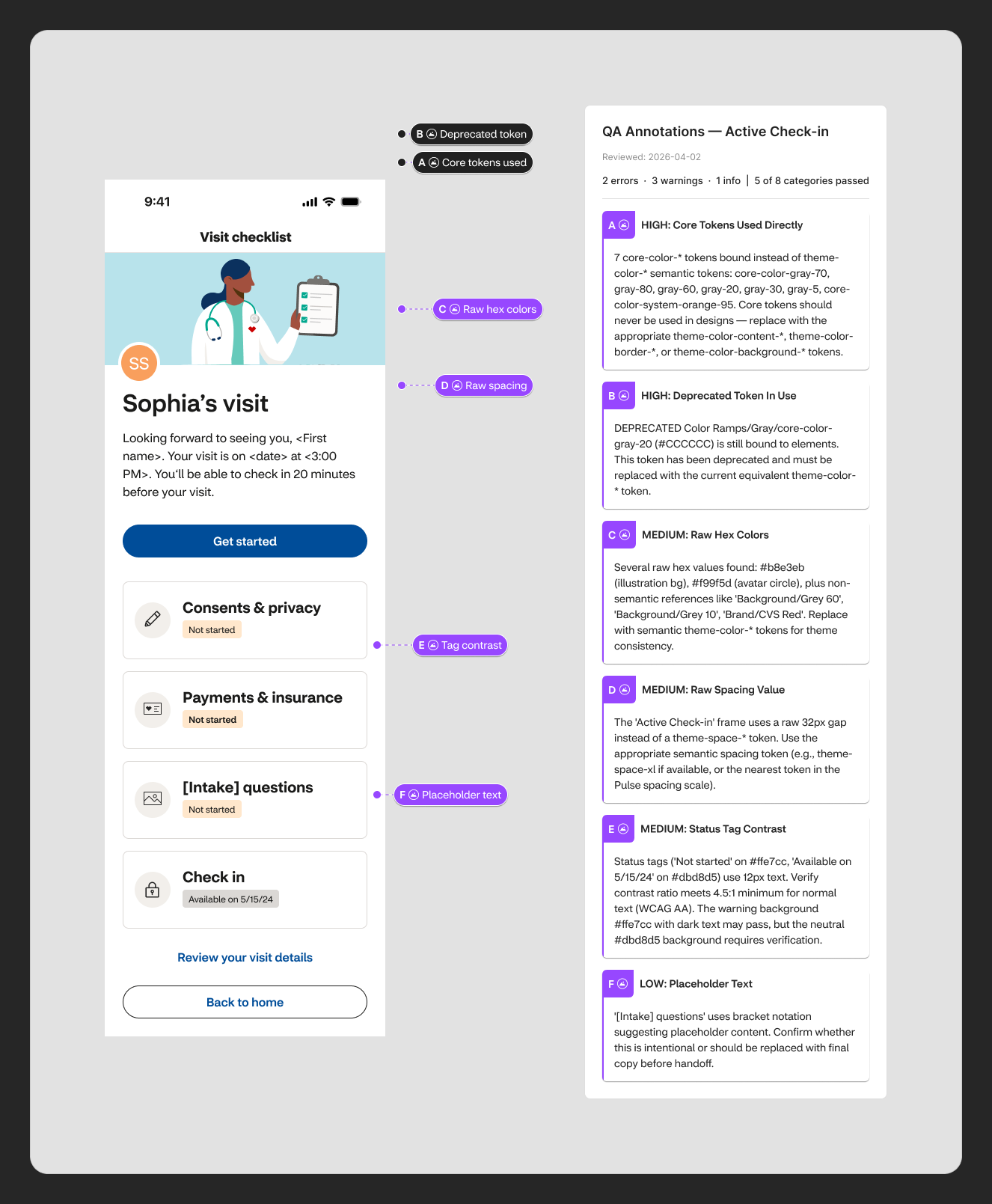
A single automated reviewer would have been faster to scope, but it would just replace one team's workflow. Instead: three skills spanning discovery, quality assurance, and delivery. Pulse Self-Check runs mid-design: Claude reviews screens against the full design-system documentation and flags token violations, wrong components, and deprecated patterns, ranked by severity, with no submission queue. Handoff Annotation runs before developer handoff: Claude identifies components and places the correct annotation stamps from the platform kits directly in the Figma file. Research Integration, still in exploration, will surface relevant findings inside the design conversation itself.
Determine training data and permission boundaries precisely enough to trust
The hardest part was deciding what Claude needed to know for its answers to be reliable. For Self-Check, I connected the full Pulse documentation via MCP: component specs, usage patterns, states, themes, token docs. A token violation only means something if the model understands the token system completely; a deprecated component only gets flagged if it knows the deprecation history.
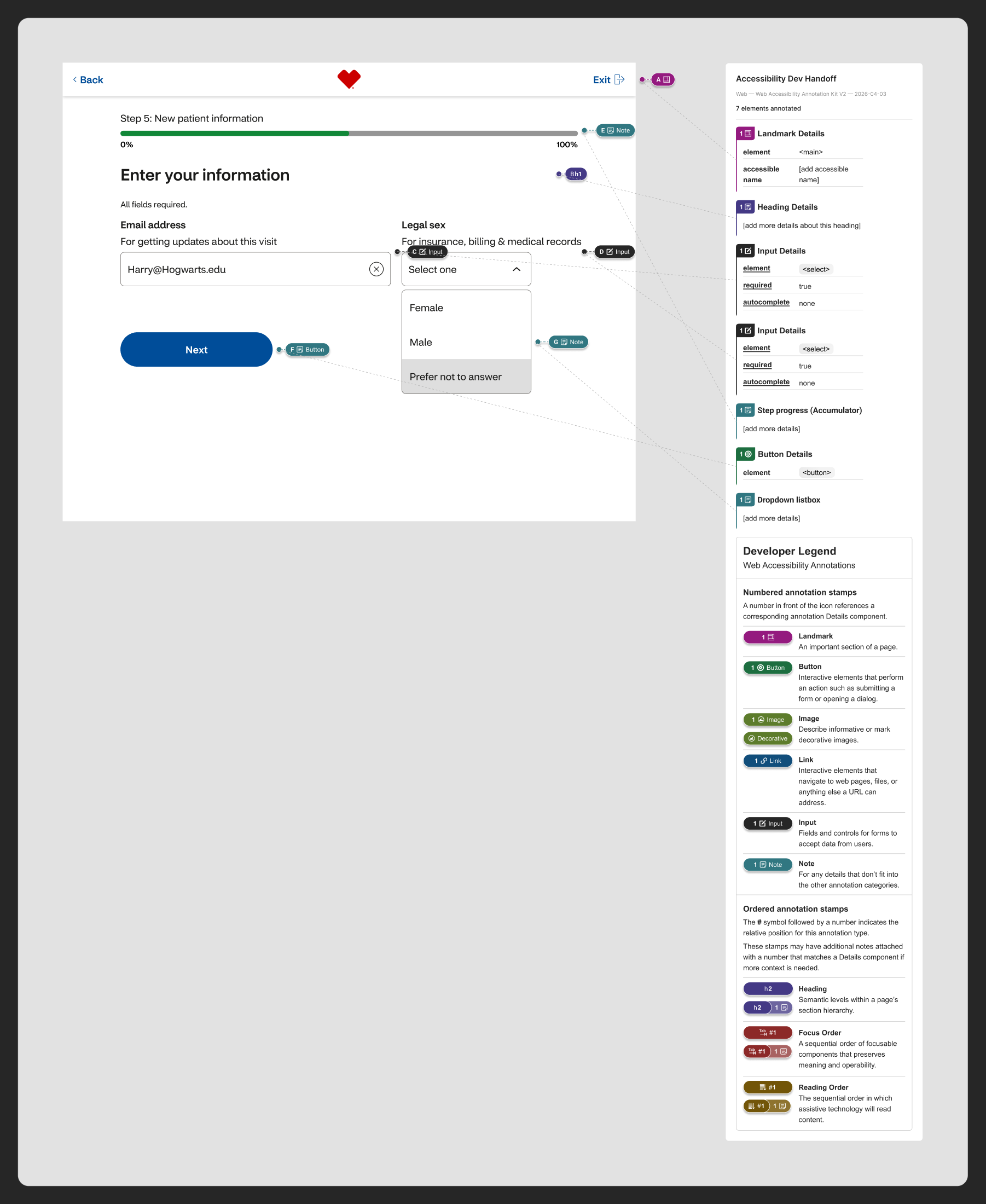
For Annotation, the challenge was placement and platform semantics: iOS stamps differ from web, and a stamp is only useful in exactly the right position. Figma shipping official write-to-canvas support, days before I planned a third-party workaround, let me build it on native tooling.
The barSpecificity is what makes output reliable enough for accessibility partners to build on. Bounded training data is why the first two skills work.
Keep the human judgment layer intact
This is what keeps the work from being a replacement story. Claude flags; I decide which flags matter: a deprecated component might be necessary for backward compatibility. Claude places the structural annotations; I add the notes where nuance matters. The accessibility team still validates every output.
The shiftThe old loop forced a full submission and a wait. Now the designer and the check iterate live, while decisions are still malleable, the check is preserved without the bottleneck.
The solution
In practice: I open a Figma file, ask for a review against Pulse, and get ranked feedback immediately: "Token violation: background should be brand-blue-500, not custom #2A3F5F. Severity: high." For handoff, I move screens into a designated section, pass the link, and the annotations populate: the right kit per platform, positioned against the actual visual hierarchy. Then I add the human notes: "this measurement is approximate on first load."
The three skills are phases of one coherent pipeline: discovery surfaces research, design quality ensures compliance, delivery prepares handoff. A designer moving through it hits structural checks at every inflection point, without ever submitting work for external review or waiting on a partner's calendar.
The outcomes
The efficiency is real, but it isn't the point. Moving the quality check to where it can inform the work, instead of validating it after the fact, is. Self-Check has caught token violations and deprecated components that would have shipped. Annotation prep now makes accessibility sessions focused, because the structural setup is already done. The skills are being refined with my team and accessibility partners ahead of a broader organizational rollout; research integration is the open frontier.
What I took from this
Quality infrastructure and headcount are different problems. You can remove the headcount and keep the checks, if you're precise about what the checks actually do.
The structural tasks respond well to AI. The judgment and the relationships don't. My role became more selective, not less engaged: less mechanical work, more thinking about whether the feedback applies to this design in this context. And AI workflow tools aren't interesting because they're fast; they're interesting because they can restore coordination to teams that have lost it.